Korean food has a reputation for being red and fiery, and plenty of it is. But a big part of everyday Korean cooking has no chili at all: grilled meat in a sweet soy marinade, milky bone soups, black bean noodles, egg dishes. If you can’t handle spice, or you’re traveling with kids, you can eat very well in Korea. You just need to know which dishes are safe, which ones only look mild, and one or two phrases to ask.
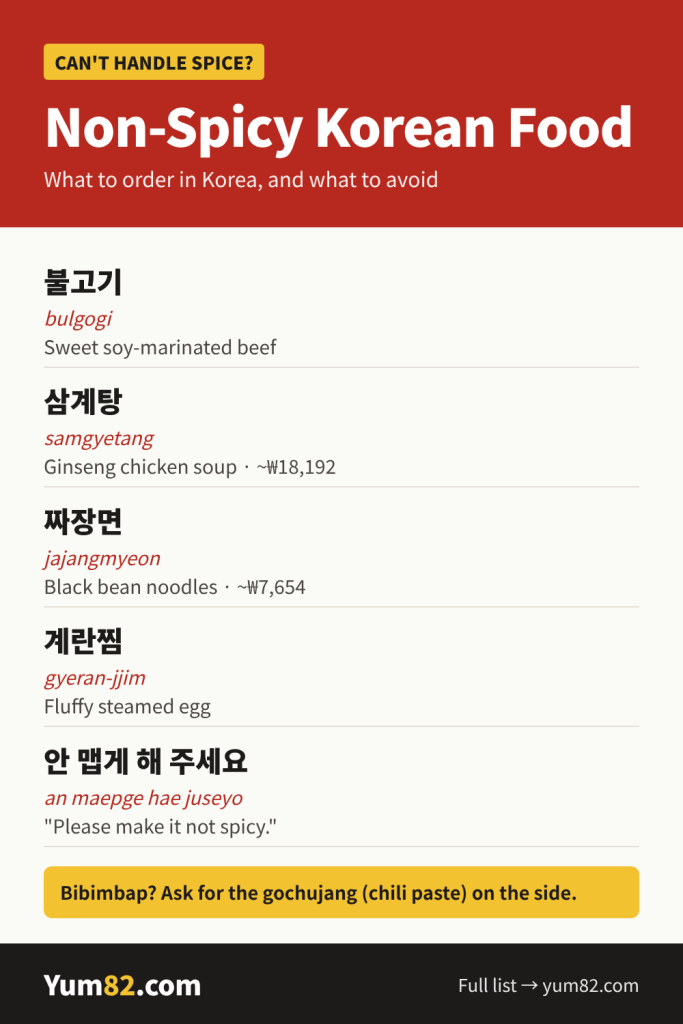
Quick answer: the safest non-spicy Korean dishes are bulgogi, galbi, samgyetang (ginseng chicken soup), seolleongtang (beef bone soup), jajangmyeon (black bean noodles), japchae, gyeran-jjim (steamed egg) and plain gimbap. Be careful with bibimbap (ask for the chili paste on the side), tteokbokki and anything red. To ask, say 안 맵게 해 주세요 (an maepge hae juseyo), “please make it not spicy.”
Love Buldak but not the burn? See the least spicy Buldak flavors, ranked by Samyang’s official Spicy Level.
Testing your limits instead? See how hot each flavor gets in our Buldak guide.
Non-spicy Korean dishes you can order safely
| Dish | What it is | Average price in Seoul (July 2026) |
|---|---|---|
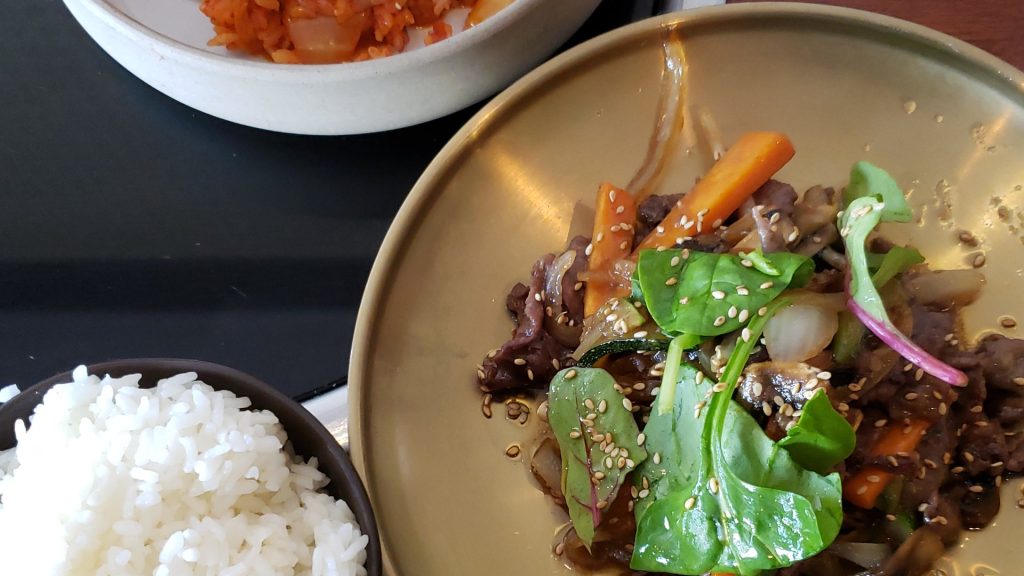
| Bulgogi 불고기 | Thin beef in a sweet soy and garlic marinade | Varies by restaurant |
| Galbi 갈비 | Grilled marinated beef or pork ribs | Varies by restaurant |
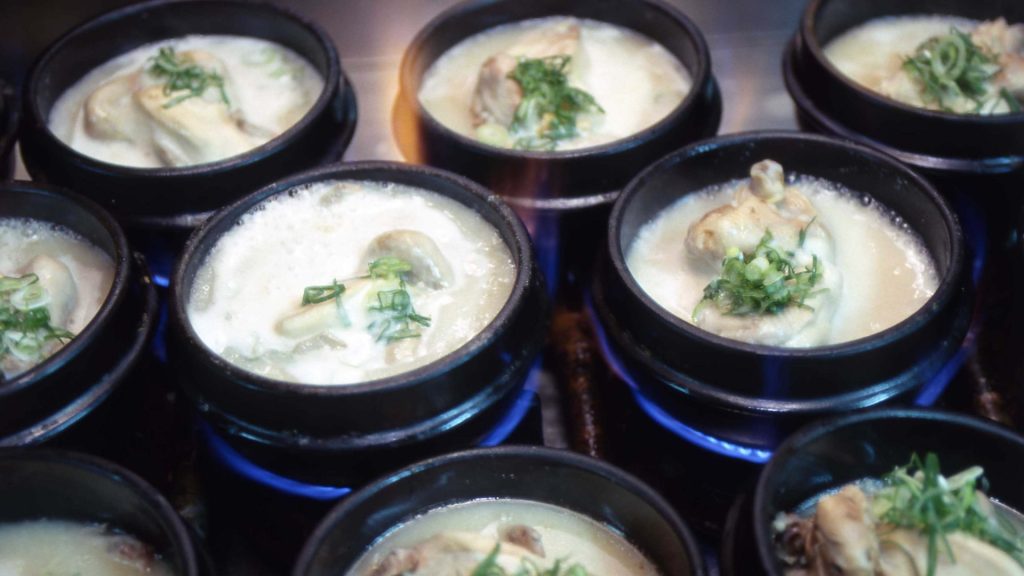
| Samgyetang 삼계탕 | Whole young chicken soup with ginseng and rice | ₩18,192 |
| Seolleongtang / gomtang 설렁탕 / 곰탕 | Milky beef bone soup, salted at the table | Varies by restaurant |
| Kalguksu 칼국수 | Knife-cut noodle soup | ₩10,038 |
| Jajangmyeon 짜장면 | Noodles in a black bean sauce, savory and a little sweet | ₩7,654 |
| Mul-naengmyeon 물냉면 | Cold buckwheat noodles in icy broth | ₩12,692 |
| Gimbap 김밥 | Rice and fillings rolled in seaweed | ₩3,869 per roll |
| Japchae 잡채 | Glass noodles stir-fried with vegetables | Often a free side or a small dish |
| Gyeran-jjim 계란찜 | Fluffy steamed egg in a hot pot | Often a free side at BBQ places |
| Mandu 만두 | Dumplings, steamed or fried | Varies by restaurant |
| Pajeon 파전 | Savory green onion pancake | Varies by restaurant |
Average prices are the Korea Consumer Agency’s July 2026 figures for Seoul, reported by NewDaily; the agency publishes them every month on its price site. Dishes without an official average vary too much between restaurants to give one number.
Watch out for spicy add-ons
- Kimchi and side dishes: the free banchan usually include kimchi and other red dishes. You can simply skip them; nobody minds.
- Ssamjang at BBQ: the thick dipping paste served with grilled meat has chili paste in it. Use salt and sesame oil instead.
- Gimbap with “ttaengcho” (땡초): this means very hot green chili. Order basic gimbap or tuna gimbap.
- Naengmyeon: mul-naengmyeon is the cold broth version; bibim-naengmyeon comes in a spicy red sauce.
Dishes that look mild but are often spicy
| Dish | Why to be careful | Safer move |
|---|---|---|
| Bibimbap | Comes with gochujang (red chili paste) to mix in | Ask for the gochujang on the side and add a little, or skip it and use soy sauce |
| Tteokbokki | The classic street version is red and spicy | Look for gungjung tteokbokki, the soy-sauce “royal court” version |
| Jjamppong | The red seafood noodle soup next to jajangmyeon on Chinese-Korean menus | Order jajangmyeon instead |
| Kimchi jjigae, dakgalbi, yukgaejang | Chili is the base of the dish, so it cannot be made mild | Pick a soup from the safe list |
| Fried chicken | “Yangnyeom” chicken has a sweet but spicy red glaze | Order huraideu (plain fried) or ganjang (soy-garlic) chicken |
Can the kitchen just make it less spicy? Sometimes. Many sauces are made in advance, so for chili-based dishes the honest answer is often no. It is easier to choose a dish that is mild to begin with.
Order like a local
Korean has a polite way to say all of this, and staff are used to visitors who don’t eat spicy food. Point at the menu and use one of these:
- 이거 매워요? (Igeo maewoyo?): Is this spicy?
- 안 맵게 해 주세요. (An maepge hae juseyo.): Please make it not spicy.
- 덜 맵게 해 주세요. (Deol maepge hae juseyo.): Please make it less spicy.
- 고추장은 따로 주세요. (Gochujang-eun ttaro juseyo.): Chili paste on the side, please.
- 순한 맛 있어요? (Sunhan mat isseoyo?): Do you have a mild version?
- 물냉면 하나 주세요. (Mul-naengmyeon hana juseyo.): One cold broth noodles, please.
- 간장치킨 반 마리 주세요. (Ganjang chikin ban mari juseyo.): Half a soy-garlic chicken, please.
If staff answer 조금 매워요 (jogeum maewoyo, “a little spicy”), treat it as spicy. Korean “a little” is usually more than most visitors expect.
FAQ
Is all Korean food spicy?
No. Many everyday Korean dishes have no chili at all, including bulgogi, galbi, samgyetang, seolleongtang, jajangmyeon, japchae, gyeran-jjim and plain gimbap. The red side dishes such as kimchi are easy to skip.
What is the least spicy Korean food?
Bone and chicken soups such as samgyetang and seolleongtang, steamed egg (gyeran-jjim) and bulgogi have no chili at all. They are good choices for children and anyone who cannot eat spice.
How do you say “not spicy” in Korean?
Say 안 맵게 해 주세요 (an maepge hae juseyo), “please make it not spicy.” To ask whether a dish is spicy, say 이거 매워요? (igeo maewoyo?).
Is bibimbap spicy?
Bibimbap itself is mild, but it comes with gochujang (red chili paste) that you mix in. Ask for it on the side (고추장은 따로 주세요, gochujang-eun ttaro juseyo) and add as much as you like.
Is jajangmyeon spicy?
No. Jajangmyeon is noodles in a savory black bean sauce with no chili. Its red neighbor on the menu, jjamppong, is spicy.
More Korean food guides
- Gimbap and ramyeon: how to order at a gimbap shop
- Seoul food prices 2026
- What Korean restaurant staff say to you
- Buldak guide: spice levels and flavors